Why Visit CIIF 2026: The Combined Value of Robotics, Industrial Automation and Smart Manufacturing
2026-09-26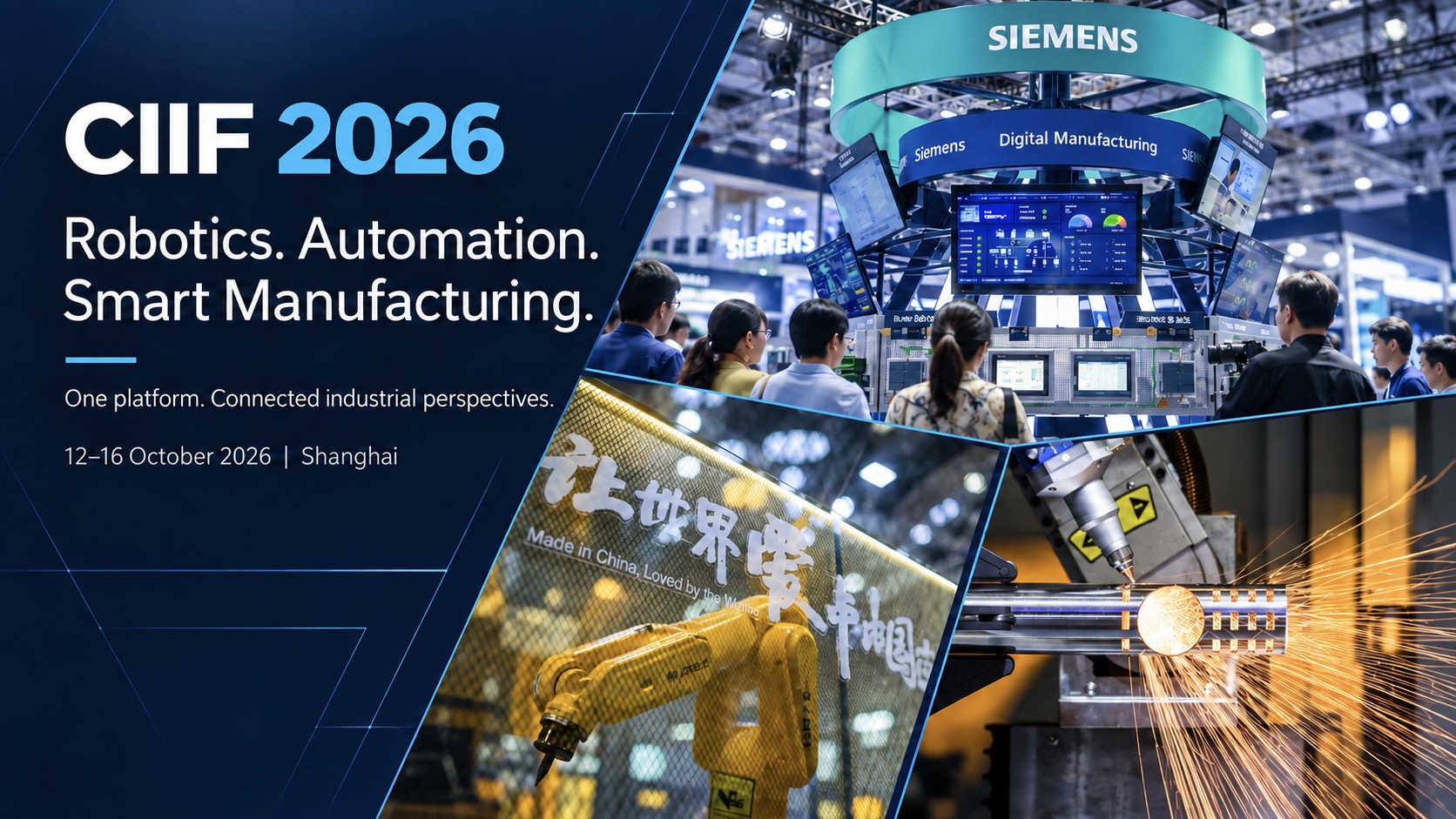
A robot purchase can lead to questions about tooling, line control, quality inspection and production data. A factory digitalisation project can expose the need to connect existing equipment, improve process visibility or rethink maintenance. For industrial decision-makers, the most valuable technology conversations often happen where these disciplines meet.
China International Industry Fair (CIIF) brings those conversations together in Shanghai. Scheduled for 12–16 October 2026 at the National Exhibition and Convention Center (Shanghai), the 26th CIIF will feature ten theme shows spanning manufacturing equipment, automation, robotics, intelligent manufacturing, energy, mobility, materials, innovation and integrated circuits.
For production leaders, engineers, system integrators, procurement teams and technology developers, this creates a compelling reason to visit: the opportunity to investigate a manufacturing challenge across several connected technology domains within one industrial exhibition. The Industrial Automation Show (IAS), Robotics Show (RS) and Advanced Intelligent Manufacturing Show (AIMS) sit within the wider CIIF platform, connecting specialist product discussions with the systems and applications that give them practical value.
Shanghai: a meeting point for industrial technology and manufacturing demand
Established in 1999, China International Industry Fair combines exhibitions, trade, awards and forums. Its Shanghai platform brings technology suppliers into contact with manufacturing enterprises and professional buyers, supporting product discovery, technical exchange and business discussions across industrial sectors.
The scale of the surrounding market adds context. The International Federation of Robotics reports in its World Robotics 2025 executive summary that China accounted for 54% of global industrial robot installations in 2024, with 295,045 units installed. For robotics and automation professionals, this makes understanding manufacturing demand in China particularly relevant to technology and business development.
For international visitors, the attraction extends beyond seeing equipment. CIIF offers a setting in which to discuss how technologies relate to manufacturing requirements in China, explore potential supplier and integration relationships, and compare different approaches to a production challenge. For businesses already active in the market, it provides an opportunity to revisit technology assumptions and investigate adjacent capabilities.
Consider the different perspectives within a factory investment team. Production specialists focus on process stability and operating requirements. Engineering teams assess interfaces and implementation constraints. Procurement evaluates supplier capabilities and lifecycle costs. Digital manufacturing teams examine data availability, software integration and system ownership. A useful exhibition visit gives these groups a shared basis for discussion.
CIIF's breadth supports that exchange. A conversation that starts with a robot can continue into automation, industrial software, machining or materials. A discussion about production energy use can connect with equipment management and intelligent manufacturing. The result is a wider technical context for evaluating individual products and deciding which suppliers merit a deeper follow-up.
IAS, RS and AIMS: a connected view of the modern factory
IAS, RS and AIMS are three theme shows within China International Industry Fair. Their relationship is central to CIIF's appeal for visitors interested in robotics, industrial automation and smart manufacturing: each addresses a different part of the same industrial challenge.
IAS presents industrial automation products, technologies and system solutions. RS covers the robotics industry chain and its industrial and service applications. AIMS centres on the connection between AI and manufacturing, including the industrial internet, industrial software, cloud and big data, computing infrastructure, wireless communications and IT/OT security.
| Manufacturing question | Relevant CIIF theme | What to investigate |
|---|---|---|
| How can equipment and processes work together? | Industrial Automation Show (IAS) | Automation architecture, equipment interfaces, operational requirements and integration responsibilities. |
| Which tasks are suitable for robotic deployment? | Robotics Show (RS) | Application fit, tooling, handling conditions, cell integration and requirements for dependable operation. |
| How can production data support better decisions? | Advanced Intelligent Manufacturing Show (AIMS) | Industrial software, connectivity, AI applications, data requirements and deployment considerations. |
This combination is useful because an attractive demonstration is only the beginning of a technical evaluation. Industrial visitors need to understand the conditions behind it: the workpiece, operating environment, upstream and downstream equipment, available data, and the people responsible for supporting the installation. Moving between these three theme shows helps visitors examine those questions from several perspectives.
Robotics: from the individual machine to the complete application
At RS, a productive conversation starts with the task. Handling, assembly, welding and inspection create different requirements for reach, payload, tooling, precision and process control. Visitors can use their own application conditions to explore how a proposed robotic solution would fit into production.
For a machine-loading project, for example, the questions extend from the robot to how parts are presented, gripped, positioned and transferred. For an assembly process, the discussion may involve product variation, fixtures, inspection and changeovers. These are useful points for distinguishing a promising concept from a solution that deserves a detailed engineering study.
The wider CIIF setting gives these conversations additional depth. RS can provide the robotics starting point, IAS can extend the discussion into automation and system coordination, and MWCS can connect it to the manufacturing equipment or process being served. AIMS adds the software and data perspective where production monitoring or traceability forms part of the objective.
CIIF's 2026 robotics plans also include further expansion of the Humanoid Robotics Zone and the Intelligent Elderly Care Service Robotics Zone. For industrial R&D teams, these areas offer an additional reason to investigate emerging approaches. The useful questions concern task suitability, operating conditions, autonomy and support requirements, alongside the engineering steps needed to move towards practical deployment.
Industrial automation: examine the interfaces that determine project scope
IAS is relevant to visitors considering new production capacity, equipment upgrades or integration across an existing line. Its focus on automation products and system solutions gives engineering and production teams a specialist setting for discussing how their processes should operate together.
For an established factory, the starting point may be compatibility with installed equipment. Visitors can ask which interfaces are supported, what information can be exchanged, how operational changes would be implemented, and where integration responsibilities would sit. For a new installation, the discussion can begin with the intended operating sequence, expansion needs and maintenance approach.
The OPC Foundation’s overview of OPC Unified Architecture describes a platform-independent framework for information exchange from machines to enterprise systems, including information modelling and security capabilities. For visitors exploring automation at CIIF, this provides a useful technical reference for asking suppliers about supported interfaces, the meaning of exchanged data and the integration work required.
These questions also give procurement teams a more useful basis for comparison. Alongside equipment specifications, they can investigate commissioning requirements, technical support, training, documentation and access to replacement components. Such discussions help define the information needed for subsequent supplier evaluation.
Combining IAS with RS and AIMS allows visitors to carry the same project requirements into related discussions. A proposal for robotic handling can be considered alongside line coordination and production visibility, helping a team identify dependencies before progressing to a formal project brief.
Intelligent manufacturing: connect AI and software with a defined operational need
AIMS provides a route into the digital side of manufacturing. Its coverage includes industrial AI, software and operating systems, cloud and big data, algorithms and computing infrastructure, the industrial internet, and IT/OT security. That range is relevant to teams exploring how digital technologies can support equipment, processes and operational decisions.
The strongest starting point is a defined use case. A manufacturer investigating quality inspection can ask what data is required, how results would be validated and where decisions would enter the production process. A team exploring maintenance applications can discuss available equipment data, the output expected from the system and how that output would support maintenance work. These questions keep the evaluation tied to an operational need.
The U.S. National Institute of Standards and Technology (NIST), in A.I. for Smarter Factories, highlights the influence of data quality during training, testing and operation on AI performance. That perspective gives AIMS visitors a concrete evaluation point: ask what data underpins an application and how its performance would be assessed under their own production conditions.
Deployment questions deserve equal attention. Where would data be processed? How would the proposed software connect with existing systems? Who would maintain the application as equipment, products or processes change? What access controls and support arrangements would be needed? These are practical discussion points for IT and operational technology teams visiting together.
CIIF's combination of AIMS, IAS and RS helps make that assessment more concrete. Visitors can relate software and AI discussions to the equipment and applications being considered elsewhere in the exhibition, building a fuller picture of the technical requirements behind an intelligent manufacturing project.
Ten theme shows connect the production floor with the wider industrial chain
The ten theme shows planned for CIIF 2026 give visitors several routes into the same industrial ecosystem. Alongside IAS, RS and AIMS, seven specialist shows extend the view into the processes, infrastructure and technologies that influence manufacturing decisions.
The Metalworking and CNC Machine Tool Show (MWCS) covers laser processing and sheet-metal stamping, metal cutting and additive manufacturing, and machine-tool accessories and peripheral products. For visitors researching automation, this provides the process context: what is being manufactured, which equipment is involved, and where handling, measurement or other supporting capabilities may be needed.
The Energy Show (ES) spans clean energy, new energy and green intelligent systems. Its scope includes wind, solar, storage, hydrogen, smart grids and integrated energy services. The Green Low-Carbon Show (GLCS) focuses on zero-carbon parks and factories, with coverage of industrial energy-use equipment management, operation, maintenance, retrofitting and upgrades. Together, these themes give plant and facilities teams additional perspectives on the infrastructure supporting production.
The New Material Industry Show (NMIS) connects materials with applications across new energy, transportation, low-altitude and commercial-space industries, AI and humanoid robotics, and other fields. For product developers and manufacturing engineers, it creates an opportunity to consider materials alongside processing and equipment choices. Those connections are especially relevant when investigating changes in product design or manufacturing methods.
The IC Ecosystem Show (ICES) covers the path from chip design through manufacturing, packaging and testing to industrial solutions and applications. Its connection with smart factories, automotive electronics and embodied intelligence adds a component and systems perspective to the broader intelligent manufacturing discussion.
The Future Transportation Industry Show (FTIS) brings together intelligent connected vehicles, the low-altitude economy, new energy, key components and future mobility ecosystems. The Scientific & Technological Innovation Show (STIS) presents research and technological achievements from institutes, universities and enterprise R&D departments, with an emphasis on industrialisation. These areas give visitors additional routes for exploring emerging applications and potential technology relationships.
This structure makes CIIF relevant across automotive, electronics, equipment manufacturing, energy, materials and other industrial sectors. The value is in how the themes can be combined around a particular objective.
An automotive supplier investigating a production upgrade might connect machining and robotic handling discussions with materials and electronics. An equipment manufacturer could examine automation and industrial software alongside component options. An electronics business may find a useful path between IAS, AIMS and ICES. A plant team responsible for operational improvements can combine automation discussions with energy systems and equipment lifecycle management.
For each audience, the exhibition becomes a way to explore the relationships between technology choices. Visitors can begin with their immediate requirement and then investigate the adjacent capabilities that could influence implementation, supplier selection or future development.
International participation backed by completed-edition facts
CIIF's international reach is supported by documented participation. According to the CIIF 2025 After Show Report, the 2025 edition hosted 3,011 exhibitors from 27 countries and regions. It attracted 186,290 individual trade visitors from 133 countries and regions, accounting for 223,997 visits during that edition.
The specialist shows also had substantial participation in 2025: IAS hosted 655 exhibitors, RS hosted 415, and MWCS hosted 716. These completed-edition figures illustrate the depth of the established platform behind the forthcoming CIIF 2026 programme.
The 2025 audience spanned equipment and electrical machinery, electronics and communications, software and IT, energy, instruments, automotive and metal products. The report's purchasing-role profile included decision-makers as well as people who advised on, recommended or specified purchases. For technology businesses, that places technical evaluation and commercial discussion within the same visitor environment.
For overseas industrial professionals, the attraction is the combination of international participation and exposure to manufacturing requirements across sectors. CIIF offers a setting for examining technology, discussing applications with potential suppliers and partners, and building a more informed view of the industrial market. The historical figures provide evidence of that reach while keeping the upcoming 2026 edition distinct from completed results.
A visit that supports the next engineering and business conversation
CIIF 2026 is particularly relevant to teams whose decisions cross functional boundaries. Production and engineering colleagues can compare their understanding of a process. Procurement can develop questions about supplier capability and support. Digital teams can assess how proposed applications relate to existing systems. R&D can look beyond the immediate project towards materials, components and emerging technologies.
Bringing a clear application brief helps make those conversations useful. A description of the process, product variation, operating constraints and desired improvement gives suppliers something concrete to address. It also helps visiting colleagues compare what they learn across the exhibition and identify which discussions deserve further technical work.
The opportunity in Shanghai is to see manufacturing as a connected system: equipment and robotics, automation and software, materials and components, energy and industrial applications. With ten theme shows on one platform, CIIF 2026 gives industrial visitors the breadth to investigate these connections and the specialist focus to pursue the details that matter to their work.
Explore CIIF 2026 on the official CIIF website for the latest theme-show information, exhibitor updates and official visitor services.